Voices From The Shadows
The Sam Dees Interview
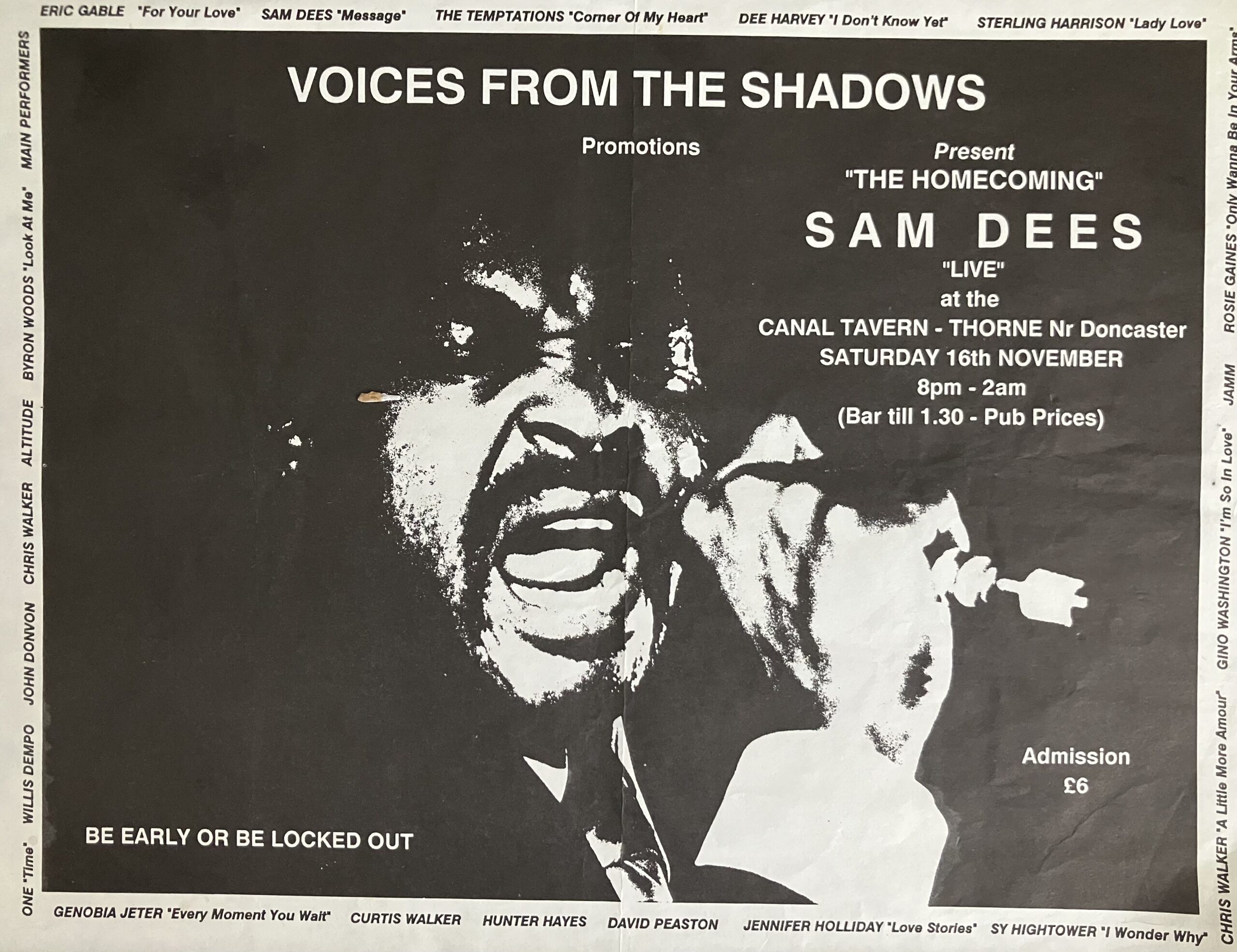
We sat there, huddled together like conspiritors, in a caravan on a windswept site on the north-east coast. For us all it was an experience we’ll never forget.’Fifteen years of relief pouring out over a mere four hour spell. We cannot publish the entire text of the interview for a variety of reasons, but below is the bulk of it.
THE CAST
Sam (“Are these guys for real!?!”) Dees
Pat (“Oh yes they are”) Person Moore
Tim (“I can’t believe this is happening”) Brown
Jan ( Just one more photo…”) Barker
Mike (“Oh my God” ) Charlton
Mark (“Near to tears”) Caldcleugh
Rod (“Unbelievable”) Dearlove
Suzanne (“Stunned into a 4 hour coma”) Cameron
Lorraine (“Pinch me so I know it is real) Dearlove
Within its near thirty-year life span soul music divides into many different sub-categories and I felt that
“The Show Must Go On” album represented the zenith of the marriage between seventies technology and sixties emotion. Other records from Sam Dees cemented that bond with catalyst of imagination and genuine quality, but more more than even that, I knew he was a songwriter and producer bar none.
In effect, I felt Sam Dees was nothing short of a soul genius.
Imagine then, my pre-conceptions when I learned that Sam Dees was to briefly perform in the UK and that I might meet the maestro himself. Anticipation and impatience were understatements.
In my sub-conscious lurked the fear that I was expecting too much; that the oceans and miles which separate us in the UK from our American heroes elevate to a mysticism which no human being can physically manifest. I was not to be disappointed. Sam Dees performed with the bitter/sweet anguish
we know on vinyl but also with a professionalism and poise which can only be gleamed by seeing the man live. The icing on the cake for me was to find that Sam Dees is an absolute gentleman and has
emerged from the bumpy road of life with a clear vision.
It was a true inspiration to find that my own thoughts on our music were in many ways shared by a man of such musical talent t and musical experience. If we are not to be submerged by the sea of expendable flotsam generated by the voyage towards the might dollar, then we must stand up at all times for what is good. Everyone who buys the the records in it is contributing towards the fight against the junk that currently permeates black music in the name of money. Believe me, guys like Sam Dees are on our corner. Cream like that will rise to the top and we will overcome – someday!
Q – What are your recollections of your first recording on S.S.S. International Records?
A – We cut that one in Nashville – I can’t remember too much, it’s a long time ago (laughs) but I do remember three white musicians plus a black guy, William Crump, who fix up the deal with Shelby Singleton. It was a one-off session – all the musicians got paid but I never saw any money from it.
Q – Your next recordings were on Lolo produced by Bob Groves.
A – Bob Groves was a studio owner in Birmingham. He gave us a deal to let us use his studios.
He had gotten a group from Louisiana, a group called the Cold Grits that later played on the
“Mustang Sally” and “Dr Feelgood” sessions at Criteria Studios. This band played on “Don’t Keep Me Hanging On” but the flipside was done in Memphis with Lelan Roger. I was sent there by Nate McCalla the Lolo owner. If he said go to Memphis – boy, you went there!
Q – You were starting to write by this time, but you did song two tremendous song on Lolo that were written by you – “Easier To Say Than Do” and “It’s All Wrong, It’s All Right’. Who chose those numbers?
A – We got a call from Quin Ivy at Muscle Shoals they were getting ready to do it on Percy Sledge and although it was a great song he did’t think they would use it as a single. Later on we cut it again on Bill Brandon in different way.
Q – It was around this time Moonsong Publishing came into being.
A – Yeah, that’s right, around 1969.
Q – This takes us on the two release on Chess which were the first occasion on which you were able to sing, write and produce. Were you happier with this?
A – Yes I was. Part of this was due to Lenny Sachs, the executive producer. We went to Macon, Georgia and did a lot of work with Johnny Sanlin who was working with Allman Brothers Band.
Lenny suggested that we see what I was capable of and “Love Starvation” was the result.
“Maryanna” was as much Johnny Sanlin’s idea as mine. We cut the other two tracks, for instance
“Can You Be One Man Woman” in Birmingham at the old Ed Bowtwell studios which were in a big disused church.
Q – You used Dale Warren on string and horn arrangements. Were these dubbed on afterwards?
A – No, they were done at the time. I would do the rhythm tracks then Dale would come in and do the strings.
Q – In the UK Dale Warren trends to be associated with sixties Detroit soul.
A – He was very respected in the music business and worked a great deal out of Ardent Studios, Memphis with Isaac Hayes and the guys at Stax. He had done some with Berry Gordy and a guy I was working with at Moonsong named Clinton Moon turned turned us on to this guy – he was more an arranger than a producer or songwriter but he could do some amazing things around those funky tracks.
We did a song on a lady named Rozetta Johnson,”A Woman’s Way” – Dale rang me and did some overdubs at the Sound of Birmingham Studios organised by Jesse Lewis…
Q – It’s interesting that you mention Jesse Lewis he was starting to share songwriting credits with you on some songs. Is he the same guy as the singer J J Lewis Malco, Motion?
A – OK -No! Jesse Lewis was a newpaper guy and he neverwrote a song in his life. There were things I had to do to keep the music thing going. We had to make certain deals we didn’t necessarily want to do and that was one of those.
Q – Did the Clintone and Moonsong labels run simultaneously?
A – Yes. They were around about the same time.
Q – One prominent singer on Clintone was Rozetta Johnson. Was she in any way connected to Lorraine Johnson?
A – No, not at all.
Q – Another singer we all rate very highly over here is C L Blast who recorded three song on Clintone.
A – He was another Birmingham artist, in fact, I worked with most of the recording artists in the town at that time.
Q – There was a group on Clintone called Black Haze Express. It sounds as if the group included you -I’m sure we can hear your voice in there.
A – Yeah, David Camon and myself did the vocals because the band itself didn’t know where they were coming from. I wasn’t doing lead vocals you understand, but I certainly helped with the background singing.
Q – And what therefore was Vulcan Records who put out the next Black Haze Express record “Stop This Merry-Go-Round” / “Black Tattle” ?
A – It was just a subsidiary lable I used to the material out.
Q – How about the Blast Furnace Band – were you in that group as well?
A – Yes I was- “Hammering Hank” – I did the lead vocals on that one. It was about Hank Garrett – he was a baseball player who was about to be the home run king – we decided to capitalize on that.
It was partially Jesse Lewis’ idea – we’ve got to give him credits somewhere.
Q – Was that the thinking behide the David Camon record “I Can’t Believe I Ate The Whole Thing” whichwas the cstchphrase on a U.S. Alka Seltzer advert at that moment in time.
A – That particular record sold quite well – around 80,000 in Chicago alone and we got prepared to perform there. I said to David – “You’d better do it, as it’s your name credited on the record”. I then got a call from his mother saying he was real sick, passed out cold. As we didn’t make any appearances, the impetus of the record was lost and it passed away.
Q – David was the only other artist on Moonsong apart from Bill Brandon who is yet another artist we all love over here.
A – Last I heard, he’d been in hospital and he was running a nightclub.
Q- I would be tremendous if you could get some of the artists we’ve mentioned back on the road again.
A – It’s a great idea and I already mentioned it to Frederick Knight a while ago. We hadn’t particularly thought of Bill Brandon or Rozetta Johnson but they could be a part of it.
Q – Do you remember Jean Battle?
A – Of course I do. “Love Marking and When A Woman Loves A Man” – a great singer.
Q – Have you any particularly favourite songs out of all the numbers that you wrote in the earlier part of your career?
A – Well I loved “Stop This Merry-Go-Round”, also “A Woman’s Way”. I was also real crazy about “Love Starvation”.
Q – Atlantic Records had picked up on your Clintone release “I’m So Very Glad” by 1973 but they changed the flipside from “Claim Jumping” to “Just Out Of Reach”. Any particular reason for this?
A – It’s just one of those things that record companies do. They were just feeling their way with me as a new artist and they thought it was a stronger song.
Q – You had started writing some powerful material relating to drug abuse, ie “Signed Miss Heroin” Child Of The Streets” in that period. It’s not a subject you’ve ever particularly returned to.
A – One of the reasons was because of the large amounts of drugs in and around Birmingham. I wanted to make my statement about it. “Signed Miss Heroin” appeared as a newspaper headline written anonymously. I took it away and wrote some words based on it and then of course recorded it.
Q – How come “Signed Miss Heroin” was not included on “The Show Must Go On” album?
A – That wasn’t my decision. It was my idea put in plus another song left called “Heritage Of A Blackman”. There are other songs I did too, all on sixteen tracks master. Atlantic hold all the rights to those.
Q – I have to say that for me and many other people “The Show Must Go On” is regarded as the ultimate all-time great soul LP. Which tracks did you record specifically for the album?
A – “Troubled Child”, “What’s It Gonna Be”, which I originally called “Brother Man” and Good Guy’s”.
Q – You wrote “Homewreckers” with Tyrone Davis which must be just about the forst thing he ever wrote.
A – We were trying hard to get recognition at this point and Lillian and myself knew were just going to have to put ourselves around and see what turned up but Tyrone actually did write that one with us.
Q – Sydney Joe Qualls also did a couple of your tunes at the same time.
A – Yeah, “Run To Me ” and “Shut Your Mouth”. I was going into the studio and doing maybe five or six demo tapes at once to make the most out of the studio time. A lot of the songs you are referring to, I would do a number of them at one time – as many as twelve on one occasion!
Q – One of the original artists at Aware was King Hannibal who has recorded your song since then.
A – He was the first guy Michael Thevis signed up and as such he became an intermediary for black talent which may have been- considering joining the label. Racism was rife in Atlanta at that time which made it difficult for an Italian like Michael to attract blacks without the original help of Hannibal.
Q – Loleatta Holloway was an enormous talent of course and “Cry To Me” quite a sizeable hit.
A – One of my favourite songs, but we hadn’t ever finished the song before the track was laid down. Floyd Smith was running around shouting “You finished with that yet?” I sat there in the control room and watched her perform that song – unbelievable, absolutely unbelievable the atmosphere in that room.
Q – What about John Edwards?
A – He was similar, but never matched that moment of Loleatta’s. He had one hell of a falsetto and could do things with his voice that no-one could touch.
Q – Atlantic by this time had put out ” Fragile Handle With Care”.
A – Sure, with Tony Sylvester and Bert DeCoteaux the song left my house in a certain way and they turned in into disco.
Q – Why did you leave Atlantic Records?
A – My relationship with Henry Allan was very poor, the respect level was not there. For instance, it appears on the album that a Randy Richards did some arrangements – it’s all bullshit. He was there but it wasn’t as it appears. Henry didn’t think that much of “The Show Must Go On” and he wouldn’t allow me any self-expression on future projects. I think he though he was going to teach this county boy a lesson.
Q – You recorded “Storybook Children” with Bettye Swann in Chicago – was this because of the earlier Tyrone Davis connection?
A – Partly, but there was a lot of crookin’ and skintin’ going on between Carl Davis and Jesse Lewis, the two of them were playing head games with songwriters thoughout the country and I was one them. Many of the things I wrote I never got royalties for.
For instance I don’t even own my songs in Moonsong publishing. The tracks were already laid down by Tom Tom Washington when we arrived and Bettye and myself decided to record face to face – we communicated real well but in fact Bettye’s husband rather got the wrong idea.
Q – It’s ironic that most of the talent in Moonsong is yours but you can’t get at it.
A – Exactly. It’s going to be difficult, to say the least, to get it back, but, hopefully, we’ll win though and you could see Sam Dees again on some of those tunes.
Q- It’s obvious to me that you care a grat deal about the past work. It’s quite unusual for instance for an artist to have copies of every record they have made as you do.
A – Lill used to say no-one will keep this record of what I was doing better than you or I, so I always kept a reference copy of everything I did.
Q – Frederick Knight probably wrote as songs in conjunction with you as anyone else. He has his studio in Birmingham, do you still see much of him.
A – All the problems and changes with Moonsong publishing made me kind of depressed with Birmingham so I moved away, but I still know Frederick.
Q- Yet another brilliant song of your is “Drop My Heart Off At The Door”.
A – By Barbara Hall and also Ben E King. I’ve done several gigs with him.
Q – Did you have anything to with Note Record label?
A – Not really, that was a record company out of Atlanta. I produced a couple of songs for them including “Beggars Can Be Choosy” on Eula Cooper – they also had a nice group called the Young Divines but I don’t think they recorded any of my material.
Q – What was the sit uation with Showtime Productions?
A – That was essentially owned by Jesse Lewis but I did a lot of creative work for them although I wasn’t involved in all the productions by any means.
Q – What made you go to Malaco studios to record “My World and “Say Yeah”?
A – Because I knew Tommy (Couch) and the record compay Polydor wanted a close association between me and some southern producer. They had named several producers and I thought I could work comforably withTommy – I have a lot of respect for what he’s doing down there at the moment. He’s not going to quit, he’s kinda like me’ he just refuses to stop doing soul music. I cut four tracks at Malaco and the president of Polydor Records suggested thre producers one of whom was David Porter.
Q – It was reported at the time that you had turned down David Porter in the past as a producer supposedly in favour of Van McCoy.
A – That’t not really true, but it goes back to Henry Allen at Atlantic. He was suggesting Tony Sylvester and Bert DeCoteaux, or David Porter or – I could get the hell out of his office! I said I’d like to involve Van McCoy – OK so he was involved with disco, a lot of disco if you like, but he had a care about music, a lot of his stuff had something special.
Q – Where dose New London International Records fit in with “Say Yeah” / “My World”?
A – It was Polydor who heard the forst release of those songs on that label, they loved the singing and the songs but not the production. They suggested that we go back in the studio and try it again.
Q – So New London reease is a different cut than the Polydor one?
A – Sure it is. (stunned silence from the assembled listeners).
Q – What happened to the other tracks you did at Malaco? At the time we hoping for an album from Polydor.
A – I was signed to Polydor and they own all the rights.
Q -Do you feel that you’d like to record at Malaco Studios again?
A – No I don’t. I feel that they are doing what they are doing and I’m doing what I’m doing.
Q – But they have used some of your sons such as Denise LaSalle’s “Keep Your Pants On”.
A – Of course I wrote the song but not with the particular intention of giving it to them, in fact the first I knew about it was from Billboard. Someone from Almo-Irving (the publishing arm of A & M) told me about it and they were kinda surprised at the song title ’cause they’re uppity and sophisticated and it wasn’t the king of thing they associated with me. But that was part of the old Chappell catalogue which had eighteen or nineteen songs in it.
Q – I don’t know what they would have thought of “Sneakers On A Rooster”.
A – Wait a minute – that was recorded – by Bo Diddley.
Q – You also did some work with the legendary Esther Phillips.
A – She was a real human being. We worked with her at Larry Graham’s studio and that was on hell of an experience. She was larger than lifeand is sadly missed.
Q – You moved to L.A. around 1977 and that commenced a very successful songwriting period for you, for example “One In A Million”. Did this success prevent you from singing?
A – It’s difficult for me to get the respect I feel I deserve as an artist from record companies. I had so much trouble in the past so I figured one way to prevent it was not to do it and I all but quit as an artist.
Q – It’s fairly obvious that vitually all the peaple who recored your songs at A & M were copying the vocal demos.
A – I had a call from producer Bobby Martin. I was in Florida at the time. He said “Listen, I’m doing three acts, Tavares, Rockie Robbins and Marylin McCoo and Billy Davis. We’re doing all your songs, will you come out here and teach them how to do them? I love Bobby Martin’s work – he’s another guy with a great feel for the music, so I did the sessions, but I remember one of the engineers turning to me and saying: “You did these song better than any any of them”. At that time I was having a lot of hassle and a human being can only handle so much at a time. but I’m here now and that’s what my new album is all about – me! When the money boat comes in and parks in my front yard, I don’t care how much it is, if it’s enough for me to make a good record and get it out on the streets then that’s what I’m going to do. I have a lot more control even down to pressing of the record.
Q – Have you any major label interest in your new material on Pen Pad?
A – Actually no-one’s heard it yet. I’ve some people to when I get back but I aren’t going to cry over that kind of deal. If it doesn’t happen then I’ll get a distribution deal and do the whole thing myself. I’m having a new studio put in my home which will make things real easy. I did all of the new tracks on a sequencer – it cut down on all the problems with musicians and producers – if it was that easy to do it all at someone elses studio, then why don’t I set up a sequencer at my own home? I’d like to re-cut some of the old material in time. The new album is tentatively called”Secret Admirer” and it should be out February / March.
Q – How did Almo-Irving come to pick up on your talents?
A – Henry Allen had set up Chappell Publishing but I didn’t feel they were serious about it and I told them that the opportunity had come to do some things with Bobby Martin in L.A. and I would be using some Chappell songs. So songs such as “Hang Tough” on Rockie Robbins or thing we cut on Tavares were Chappell songs. During the recording Almo-Irving noticed these numbers and were attracted to them. They asked me if I wrote all this stuff which I told them I did and they approached me with a view to publishing new material. That was what really brought me over to California back in 1978.
Q – How come A & M never gave you a recording contract but were prepared to put out a vocal album on a pianist like Les McCann – even down to using you on background vocals?
A – Actually , A & M did offer me a recording contract and then withdrew it, there was material in the can. I was a difficult period , I lost Lill to cancer and then yet more hassle from record companies. One of the songs from that period was “What A Way To Put It” later recorded by The Temptations and also Willie Clayton. But it’s like I’ve said all along – who knows what’s in the head of record companies?
Q – Helen Lowe was a tremendous featured vocalist on Les McCann album even down to sounding like a female Sam Dees.Whatever happened to her?
A – She joined a group called The Outsiders or something, but she just disappeared. I’ve never seen her since.
Q – You did some work with Ron Kersey on the likes of Beau Williams including some more background vocals.
A – Ron moved to L.A. from Philadelphia around the same time as Bobby Martin. There are several things I did background vocals on such as Jeffrey Osbourne, The Temptations, etc. We agreed to write some songs together ans share the production credits too.
Q – What about Gl adys Knight? You were supposed to cut a gospel album on her.
A – It’s still in the can. I have four of the songs in my house on multi-track but can’t seem to make a decision on what they want to do. We still have a production company in existence called K.D.K. and we’re still deciding what to do about that.
Q – Are there musicians you particularly want to involve yourself with in the future?
A – I’ve a few people in mind but particularly want to involve Ernie Watts who did such a fantastic job on “After All”. He just came in off the street, walked up to the microphone and – wow – that was it, in just one take!
Q – Obviously, you’ll be using new technology to make your music – do you think you can get the same feel as real musicians?
A – These are my songs. I done one daugher and she is twenty -two years old, the rest of the kids I have are these songs – believe me, no-one’s gonna treat ’em better than me – the feeling will most definitely be there. The new label belongs to me and I have the control. Let me say I have a lot of respect for what you guys in the UK are trying to do for soul music, it’s a damma shame it’s going down the tubes in the U.S. A lot of guys in black music are playing head games, searching for whatever it is, a better music or something. What’s wrong with the music we’ve got? Why don’t we enhance it? Look at rock ‘n roll – it’s been updated but it’s essentially the same when Presley or Bill Haley did it.
Q – The major labels just don’t seem to want to cater for the mature buyer of soul music at the moment, it’s all geared for the kids.
A – Therein lies the problem, some of the people in power in the industry are not interested in seeing the role that older people have in the market. If there is nothing for them to buy they won’t buy, that doesn’t mean they don’t want. Then there are the black artists who are interested in money generated by pop actssuch as the Rolling Stones or Stevie Winwood, they just want the big pop money. What the damn fools don’t realise is that good music is good music and soul music is good music. It can play on pop stations all day long if it is treated right. But havu=ing said that, that ain’t my little red wagon and I aren’t going to pull it. I’ve got my own label with its own artists and we’re gonna do our own thing and not concern ourselves with the rest of them. I want to perfect myself as an artist because I’ve all the other things. I’ll still write some songs, I’ll still produce some records but now I’m gonna sing some songs.
Interview by:
Tim Brown with assistance from the ‘soul clan’ Jan Barker, Mike Charlton, Rod Dearlove